Abstract
Acute neurocognitive effects of COVID-19 vaccines remain poorly documented, particularly in African populations. The systemic inflammatory response following vaccination could transiently modulate brain function. This study aimed to conduct an exploratory cross-sectional assessment of the acute effects of the Johnson & Johnson vaccine on selective attention and verbal memory in participants from Côte d'Ivoire. We compared the cognitive performance of 28 participants tested 30 minutes after receiving the Johnson & Johnson vaccine with 28 non-vaccinated controls. Participants were stratified by educational level (primary, secondary, university). Cognitive performance was assessed using the Stroop test and the Rey Auditory Verbal Learning Test (RAVLT). Independent samples t‑tests were applied with significance set at p ≤ 0.05. A statistically significant improvement in Stroop interference performance (selective attention) was observed in the vaccinated secondary-level group compared to controls (p = 0.005). In the primary-level group, vaccinated participants showed significantly lower scores on the RAVLT deferred recognition task (p = 0.01). No other significant differences were found for RAVLT performance or for other Stroop conditions and educational levels. This exploratory study did not find evidence of widespread acute cognitive deficits following vaccination with the Johnson & Johnson vaccine. However, the specific effects observed, a potential enhancement of attention in secondary-level group and a potential disruption of memory recognition in the primary-level group, highlight the need for larger, longitudinal studies to confirm these findings and explore the underlying neuro-immune mechanisms.
|
Published in
|
Central African Journal of Public Health (Volume 12, Issue 3)
|
|
DOI
|
10.11648/j.cajph.20261203.13
|
|
Page(s)
|
148-153 |
|
Creative Commons
|

This is an Open Access article, distributed under the terms of the Creative Commons Attribution 4.0 International License (http://creativecommons.org/licenses/by/4.0/), which permits unrestricted use, distribution and reproduction in any medium or format, provided the original work is properly cited.
|
|
Copyright
|
Copyright © The Author(s), 2026. Published by Science Publishing Group
|
Keywords
Cognitive Functions, COVID-19, Johnson & Johnson Vaccine, Neuro‑immune Response, Selective Attention, Verbal Memory
1. Introduction
The coronavirus disease 2019 (COVID‑19) pandemic, caused by severe acute respiratory syndrome coronavirus 2 (SARS‑CoV‑2), has mobilized global research efforts since December 2019 to reduce morbidity and mortality
| [20] | Zhou, P., Yang, X. L., Wang, X. G., Hu, B., Zhang, L., Zhang, W., Si, H. R., Zhu, Y., Li, B., Huang, C. L., Chen, H. D., Chen, J., Luo, Y., Guo, H., Jiang, R. D., Liu, M. Q., Chen, Y., Shen, X. R., Wang, X., Zheng, X. S., … Shi, Z. L. (2020). A pneumonia outbreak associated with a new coronavirus of probable bat origin. Nature, 579(7798), 270–273. https://doi.org/10.1038/s41586-020-2012-7 |
[20]
. The rapid development of safe and effective vaccines became the primary strategy of pandemic control, with several platforms deployed: viral vector vaccines (AstraZeneca, Johnson & Johnson), mRNA vaccines (Pfizer‑BioNTech, Moderna), and inactivated vaccines (Sinopharm, CoronaVac). While these platforms demonstrated distinct efficacy profiles and acute adverse effects varying by context and type
| [9] | Latifi, A., & Flegr, J. (2025). Persistent health and cognitive impairments up to four years post COVID-19 in young students: The impact of virus variants and vaccination timing. Biomedicines, 13(1), 69. https://doi.org/10.3390/biomedicines13010069 |
[9]
, and despite their proven success in preventing severe illness and death, potential short- and long-term side effects remain a subject of ongoing scientific investigation and public concern
| [14] | Roh, J. H., Jung, I., Suh, Y., & Kim, M. H. (2024). A potential association between COVID-19 vaccination and development of Alzheimer’s disease. QJM, 117(10), 709–716.
https://doi.org/10.1093/qjmed/hcae103 |
[14]
.
Beyond infection itself, studies have reported persistent cognitive impairments in some patients, suggesting central nervous system vulnerability to infectious and inflammatory processes
| [1] | Aderinto, N., Olatunji, G., Kokori, E., Ogieuhi, I. J., Yusuf, I. A., Egbunu, E., Ukoaka, B. M., Babalola, A. E., Adefusi, T. O., Aboje, J. E., & Moradeyo, A. (2025). COVID-19 and cognitive impairment: a review of the emerging evidence. Discover mental health, 5(1), 56. https://doi.org/10.1007/s44192-025-00189-3 |
[1]
. Neurocognitive symptoms have also been described following vaccination, though available data remain limited, heterogeneous, and rarely confirmed by standardized neuropsychological assessments
| [8] | Hotz, J. F., Kellerberger, S., Elea Jöchlinger, S., Danielova, I., Temizsoy, H., Ötsch, S., Goller, J., Yacob, M., & Zifko, U. (2024). Exploring cognitive impairments and the efficacy of phosphatidylcholine and computer-assisted cognitive training in post-acute COVID-19 and post-acute COVID-19 Vaccination Syndrome. Frontiers in neurology, 15, 1419134.
https://doi.org/10.3389/fneur.2024.1419134 |
| [9] | Latifi, A., & Flegr, J. (2025). Persistent health and cognitive impairments up to four years post COVID-19 in young students: The impact of virus variants and vaccination timing. Biomedicines, 13(1), 69. https://doi.org/10.3390/biomedicines13010069 |
[8, 9]
.
The biological rationale for a potential link between vaccination and cognition lies in neuroimmune interactions. Vaccination induces an acute inflammatory response characterized by cytokine release, which can cross the blood–brain barrier or signal through peripheral pathways, transiently modulating neuronal activity and neurotransmission
| [6] | Dantzer, R. (2004). Cytokine-induced sickness behaviour: A neuroimmune response to activation of innate immunity. European Journal of Pharmacology, 500(1–3), 399–411.
https://doi.org/10.1016/j.ejphar.2004.07.040 |
| [7] | Harrison, N. A., Brydon, L., Walker, C., et al. (2009). Inflammation causes mood changes through alterations in subgenual cingulate activity and mesolimbic connectivity. Biological Psychiatry, 66(5), 407–414.
https://doi.org/10.1016/j.biopsych.2009.03.015 |
[6, 7]
. Cognitive domains such as attention and memory, dependent on fronto‑parietal and hippocampal networks, are particularly sensitive to these neuroimmune fluctuations
.
Despite these observations, few studies have directly and objectively assessed the short‑term cognitive effects of COVID‑19 vaccines
| [3] | Brola, W., & Wilski, M. (2022). Neurological consequences of COVID-19. Pharmacological Reports, 74(6), 1208–1222.
https://doi.org/10.1007/s43440-022-00424-6 |
| [5] | Centers for Disease Control and Prevention. (2020). Coronavirus disease 2019 (COVID-19): Recommendations for cloth face covers. CDC page. |
[3, 5]
. This gap is especially critical in low‑resource settings such as Côte d’Ivoire, where demographic profiles, comorbidity prevalence, and vaccine types differ from those in international cohorts.
The present study investigates the acute cognitive effects of the Johnson & Johnson vaccine on selective attention and verbal memory, with the overarching aim of evaluating the cognitive safety of COVID‑19 vaccines administered in Côte d’Ivoire.
2. Methodology
2.1. Study Design
This research was conducted as a prospective, cross‑sectional and comparative study. Data collection took place at the vaccination center of the National Institute of Public Hygiene (INHP) located in the Treichville (Abidjan) from May 16 to June 16, 2023, in Côte d’Ivoire.
2.2. Participants
A total of 56 participants were recruited and divided into two groups: a vaccinated group (N = 28) and a non‑vaccinated control group (N = 28). The overall sample included individuals aged 18 to 65 years.
The vaccinated group consisted of volunteers recruited at the INHP vaccination center in Abidjan, immediately after receiving a 0.5 ml dose of the Johnson & Johnson COVID‑19 vaccine. Inclusion criteria were good health status confirmed by medical history review, receipt of one or two doses of the Johnson & Johnson vaccine, and provision of informed consent.
The control group comprised unvaccinated volunteers recruited from the general population in Abidjan, primarily from the communes of Cocody and Yopougon who agreed to participate without compensation.
Exclusion criteria for all participants included illiteracy (to ensure comprehension of instructions), a history of stroke, or self‑reported pre‑existing memory disorders.
Participants were stratified into three educational levels: Primary (N = 12), Secondary (N = 14), and University (N = 30). Detailed demographic characteristics are presented in
Table 1.
Table 1. Demographic characteristics of participants.
Characteristic | Vaccinated group (N = 28) | Control group (N = 28) | Total (N = 56) |
Age means (±SD) | 30 (± 10.13) | 28.47 (±5.66) | |
Gender, n (%) |
Female | 7 (25%) | 7 (25%) | 14 (25%) |
Male | 21 (75%) | 21 (75%) | 42 (75%) |
Educational Level, n (%) |
Primary | 6 (21.43%) | 6 (21.43%) | 12 (21.43%) |
Secondary | 7 (25%) | 7 (25%) | 14 (25%) |
University | 15 (53.57%) | 15 (53.57%) | 30 (53.57%) |
2.3. Sample Size and Power
An a priori power analysis was performed using G*Power 3.1 for an independent samples t‑test (two‑tailed). With 𝛼=0.05, power = 0.80, and equal group allocation, the study required 26 participants per group to detect a moderate‑to‑large effect (Cohen’s 𝑑=0.80). We enrolled 28 participants per group (total N=56) to account for potential exclusions and incomplete assessments.
2.4. Cognitive Assessment
Testing was conducted at the INHP. For the vaccinated group, neuropsychological assessments were administered individually in a quiet environment, 30 minutes after vaccine injection, to evaluate acute cognitive effects. The control group completed the same tests under standardized conditions. Two neuropsychological instruments were employed:
2.4.1. Stroop Test
The Stroop test was used to assess selective attention and cognitive inhibition. Three conditions were administered: (Ep1) reading color names printed in black (processing speed and automatic reading), (Ep3) naming colored rectangles, and (Ep4) naming the ink color of incongruent color words (interference condition). For each condition, participants named aloud as many items as possible within 45 seconds. Scores reflected the number of correctly named items
| [16] | Strauss, E., Sherman, E. M. S., & Spreen, O. (2006). A compendium of neuropsychological tests: Administration, norms, and commentary (3rd ed.). Oxford University Press. |
| [17] | Stroop, J. R. (1935). Studies of interference in serial verbal reactions. Journal of Experimental Psychology, 18(6), 643–662.
https://doi.org/10.1037/h0054651 |
[16, 17]
.
2.4.2. Rey Auditory Verbal Learning Test (RAVLT)
The RAVLT was used to evaluate verbal learning, immediate memory, and delayed recall. The test followed the standard international protocol: (1) five learning trials of a 15‑word list (List A), (2) an interference trial with a new 15‑word list (List B), followed by immediate recall of List A, (3) delayed free recall of List A after a 30‑minute interval, and (4) a delayed recognition trial. Responses were recorded comprehensively to analyze different components of memory
| [10] | Lezak, M. D. (1983). Neuropsychological assessment (2nd ed.). Oxford University Press. |
| [12] | Rey, A. (1941). L’examen psychologique dans les cas d’encéphalopathie traumatique (les problèmes). Archives de Psychologie, 28, 215–285. |
[10, 12]
.
2.5. Statistical Analysis
Data was analyzed using STATISTICA software (version 7.0). Independent samples Student’s t‑tests were used to compare cognitive performance between vaccinated and control groups. Statistical significance was set at p < 0.05. Analyses were conducted separately for each educational level (Primary, Secondary, University) to examine potential vaccine effects across educational levels.
2.6. Ethical Approval
The study was approved and authorized by the National Institute of Public Hygiene (N°1076/MSHPCMU/INHP/DBBVJ/Cta). In accordance with the principles of the Declaration of Helsinki, all participants provided written informed consent after receiving a detailed explanation of study procedures. The confidentiality of the data processed was respected.
3. Results
3.1. Characteristics of Participants
The demographic characteristics of participants assigned to the two experimental groups are presented in
Table 1.
3.2. Selective Attention (Stroop Test)
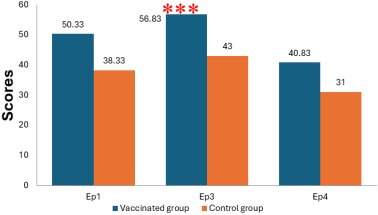
Performance on the Stroop test varied across educational levels. At the primary level, vaccinated participants achieved higher mean scores across all conditions (
Figure 1) compared to controls (Ep1: 50.3 vs. 38.3; Ep3: 56.8 vs. 43.0; Ep4: 40.8 vs. 31.0). Statistical analysis indicated a significant difference only in the color‑naming condition (Ep3; t = 2.51, p = 0.05).
Figure 1. Stroop test performance for primary-level participants (vaccinated vs. control groups).
Note: Ep1 = word reading; Ep3 = color naming; Ep4 = interference condition. Asterisks (*) indicate statistical significance at p < 0.001.
For secondary level, vaccinated participants demonstrated superior performance in the interference condition (Ep4: 62.7 vs. 33.6), with a significant difference (t = 4.16, p = 0.005), while no significant differences were observed in Ep1 or Ep3 (
Table 2).
Table 2. Stroop test scores for secondary-level participants (vaccinated vs. control groups).
| Vaccinated group | Control group |
Ep1 | 91.57 | 108.42 |
Ep3 | 67.71 | 63.71 |
Ep4 | 62.71 | 33.57* |
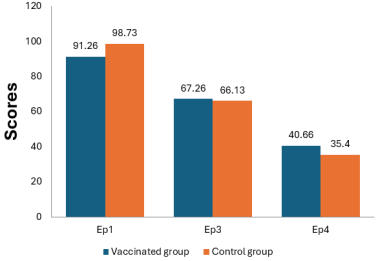
At the university level (
Figure 2), scores were comparable between groups across all conditions (Ep1: 91.3 vs. 98.7; Ep3: 67.3 vs. 66.1; Ep4: 40.7 vs. 35.4), with no statistically significant differences (all p > 0.20).
Figure 2. Stroop test scores for university-level participants across conditions.
Note: Ep1 = word reading; Ep3 = color naming; Ep4 = interference condition. Bars represent mean scores per group.
3.3. Verbal Learning and Memory (RAVLT Test)
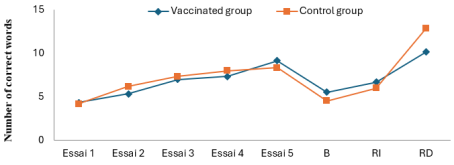
Analysis of RAVLT performance revealed consistent learning curves across groups, with progressive improvement from trial 1 to trial 5.
For primary level (
Figure 3), both groups demonstrated positive learning slopes (vaccinated m = 1.20; controls m = 1.04), and total recall across five trials was similar (33.2 vs. 34.0 words). Immediate recall, recognition, and delayed recall did not differ significantly (all p > 0.20), although vaccinated participants scored lower on delayed recognition (10.2 vs. 12.8), a difference that reached statistical significance (t = 3.73, p = 0.01).
Figure 3. RAVLT learning curve for primary-level participants.
Note: Essai 1–5 = learning trials; B = distractor list; RI = immediate recall; RD = delayed recognition. Lines represent mean number of correct words per trial.
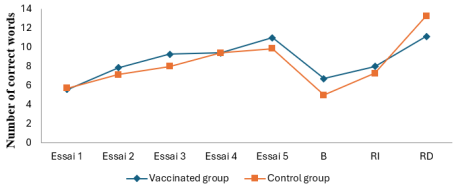
At the secondary level (
Figure 4), vaccinated participants showed slightly higher total learning (43.1 vs. 40.1 words), with comparable recall and recognition scores, and no significant differences across immediate recall, delayed recall, or recognition (all p > 0.15).
Figure 4. RAVLT learning curve for secondary-level participants.
Note: Essai 1–5 = learning trials; B = distractor list; RI = immediate recall; RD = delayed recognition. Lines represent mean number of correct words per trial.
Table 3. RAVLT performance for university-level participants across trials and recall conditions.
| Essai 1 | Essai 2 | Essai 3 | Essai 4 | Essai 5 | B | RI | RD |
Vaccinated group | 5.66 | 7.46 | 9.8 | 10.2 | 10.86 | 6.26 | 8.33 | 12.86 |
Control group | 5.46 | 8.33 | 10.2 | 10.53 | 11.26 | 6.33 | 9.06 | 13.93 |
At the university level (
Table 3), learning curves were similar between groups (vaccinated total = 44.0 words; controls = 45.8 words), and immediate recall, delayed recall, and recognition scores did not differ significantly (all p > 0.20).
Overall, the Johnson & Johnson vaccine did not produce widespread acute cognitive deficits 30 minutes post‑administration. Significant differences were limited to improved Stroop interference performance in the secondary‑level group and reduced delayed recognition in the primary‑level group. No other cognitive domains showed statistically significant differences between vaccinated and control participants.
4. Discussion
This study aimed to explore the impact of the Johnson & Johnson COVID‑19 vaccine on cognitive performance, specifically selective attention and verbal memory, in participants from Côte d’Ivoire. Results from the Stroop test and the RAVLT suggest an overall absence of major impacts in the cognitive functions assessed but highlight specific effects depending on educational level.
A notable finding of our study is the significant and highly specific improvement in selective attention among participants with a secondary education level. This improvement was observed solely in the interference condition of the Stroop test, a task that places high demands on executive control and cognitive inhibition mechanisms mediated by the prefrontal cortex
. This specificity suggests that the vaccine effect is not merely a simple increase in general arousal, but a targeted modulation of higher executive functions. These results align with studies showing that certain acute immune stimulations can transiently modulate frontal circuits involved in cognitive control
, and contrast with the inhibition deficits observed in pathological contexts such as chronic cannabis use
| [15] | Soumahoro, V. O., Diboh, E., Yao, K. M., Karamoko, G., Koffi, B., Tako, N. A., & Assi, B. (2019). Consommation du cannabis chez les jeunes élevés en Côte d’Ivoire: Effets de cette consommation sur l’attention sélective. American Journal of Innovative Research and Applied Sciences, 9(3), 269–275. |
[15]
.
Conversely, an equally specific negative effect was observed on verbal memory in participants with a primary education level. Although their verbal learning capacity remained intact, their performance on the RAVLT delayed recognition task was significantly impaired. According to the interpretive framework of the RAVLT, such a dissociation between preserved recall and diminished recognition may indicate a disruption in the quality of memory encoding
| [10] | Lezak, M. D. (1983). Neuropsychological assessment (2nd ed.). Oxford University Press. |
| [13] | Rey, A. (1964). L’examen clinique en psychologie. Presses Universitaires de France. |
[10, 13]
. The memory trace appears to be formed, but with less precision and specificity, making it more difficult to discriminate from lures. In contrast, neither of these effects, positive on attention nor negative on memory, were observed in university-educated participants, suggesting an absence of measurable cognitive modulation in this group.
These varying findings can be interpreted considering the neuro-immune hypothesis. The acute inflammatory response induced by the vaccine could have differential consequences depending on the maturity and plasticity of brain circuits. In participants with a secondary education level, the maturation of the prefrontal cortex might transiently benefit from dopaminergic or noradrenergic modulation within these circuits, temporarily enhancing their efficiency for demanding executive control tasks like the Stroop test
| [2] | Arnsten, A. F. (2009). Stress signalling pathways that impair prefrontal cortex structure and function. Nature Reviews Neuroscience, 10(6), 410–422. https://doi.org/10.1038/nrn2648 |
[2]
. In participants with a primary education level, this acute post-vaccinal inflammatory stimulation might transiently disrupt hippocampal synaptic plasticity processes, altering the specificity of memory traces, which would explain the decline in performance observed specifically in delayed recognition
| [7] | Harrison, N. A., Brydon, L., Walker, C., et al. (2009). Inflammation causes mood changes through alterations in subgenual cingulate activity and mesolimbic connectivity. Biological Psychiatry, 66(5), 407–414.
https://doi.org/10.1016/j.biopsych.2009.03.015 |
[7]
. Finally, in university-educated participants, whose brain networks and neuro-immune responses are more mature and stabilized, the cognitive system may demonstrate greater resilience to this acute and transient inflammatory perturbation. This stability likely reflects a higher level of cognitive reserve, which acts as a protective buffer against systemic insults
| [7] | Harrison, N. A., Brydon, L., Walker, C., et al. (2009). Inflammation causes mood changes through alterations in subgenual cingulate activity and mesolimbic connectivity. Biological Psychiatry, 66(5), 407–414.
https://doi.org/10.1016/j.biopsych.2009.03.015 |
[7]
. Cerebral homeostasis would thus be maintained more effectively, explaining the absence of measurable cognitive effects in this group
.
5. Limitations and Future Directions
This study has some methodological limitations. The absence of longitudinal follow‑up makes it impossible to determine whether the observed differences are transient or persistent. Another limitation concerns participant recruitment. The vaccinated group was recruited at a vaccination center, whereas the control group was drawn from the general population. This difference in recruitment context may introduce a selection bias. Results must be interpreted with caution. These conclusions should be considered exploratory.
Future research should aim to expand sample size, include multicenter cohorts, and implement longitudinal designs to assess cognitive performance over short‑, medium, and long‑term intervals. Incorporating inflammatory biomarkers (e.g., cytokines, CRP) and neuroimaging measures would provide deeper insights into underlying neuro‑immune mechanisms. Comparative studies across different vaccine platforms (mRNA, viral vector, inactivated) are also warranted to determine whether the observed effects are specific to Johnson & Johnson or generalizable across COVID‑19 vaccines.
6. Conclusion
This exploratory study suggests that the Johnson & Johnson vaccine does not induce widespread acute cognitive deficits. Findings highlight enhanced selective attention in high school level participants and reduced delayed recognition in elementary school level participants, with no measurable effects in university-level subjects. These observations underscore the need for larger, longitudinal studies using neuropsychological assessments to confirm these results and further investigate underlying neuro‑immune mechanisms.
Abbreviations
COVID‑19 | Coronavirus Disease 2019 |
RAVLT | Rey Auditory Verbal Learning Test |
INHP | National Institute of Public Hygiene |
Acknowledgments
The authors wish to express their sincere gratitude to all participants who generously took part in this study. We also extend our thanks to the National Institute of Public Hygiene (INHP) in Abidjan for providing the institutional and logistical framework that enabled the successful completion of this research. Their support was essential to the conduct of the study.
Author Contributions
Gbê Jacob Badie: Conceptualization, Data curation, Formal Analysis, Investigation, Methodology, Visualization, Writing – original draft, Writing – review & editing
Yacouba Ouattara: Conceptualization, Data curation, Formal Analysis, Software, Writing – original draft, Writing review & editing
Paterson Valery Disseka: Conceptualization, Writing – review & editing
Niangoran François Bakou: Conceptualization, Formal Analysis, Methodology, Supervision, Validation
Bi Semi Anthelme Nene: Validation, Resources, Supervision
Ahoua Yapi: Supervision, Validation
Antoine Némé Tako: Methodology, Resources, Supervision
Issaka Tiembre: Conceptualization, Resources, Supervision, Validation
Data Availability Statement
The data supporting this research are available from the authors on reasonable request.
Conflicts of Interest
The authors declare no conflicts of interest.
References
| [1] |
Aderinto, N., Olatunji, G., Kokori, E., Ogieuhi, I. J., Yusuf, I. A., Egbunu, E., Ukoaka, B. M., Babalola, A. E., Adefusi, T. O., Aboje, J. E., & Moradeyo, A. (2025). COVID-19 and cognitive impairment: a review of the emerging evidence. Discover mental health, 5(1), 56.
https://doi.org/10.1007/s44192-025-00189-3
|
| [2] |
Arnsten, A. F. (2009). Stress signalling pathways that impair prefrontal cortex structure and function. Nature Reviews Neuroscience, 10(6), 410–422.
https://doi.org/10.1038/nrn2648
|
| [3] |
Brola, W., & Wilski, M. (2022). Neurological consequences of COVID-19. Pharmacological Reports, 74(6), 1208–1222.
https://doi.org/10.1007/s43440-022-00424-6
|
| [4] |
Capuron, L., & Miller, A. H. (2011). Immune system to brain signaling: Neuropsychopharmacological implications. Pharmacology & Therapeutics, 130(2), 226–238.
https://doi.org/10.1016/j.pharmthera.2011.01.014
|
| [5] |
Centers for Disease Control and Prevention. (2020). Coronavirus disease 2019 (COVID-19): Recommendations for cloth face covers. CDC page.
|
| [6] |
Dantzer, R. (2004). Cytokine-induced sickness behaviour: A neuroimmune response to activation of innate immunity. European Journal of Pharmacology, 500(1–3), 399–411.
https://doi.org/10.1016/j.ejphar.2004.07.040
|
| [7] |
Harrison, N. A., Brydon, L., Walker, C., et al. (2009). Inflammation causes mood changes through alterations in subgenual cingulate activity and mesolimbic connectivity. Biological Psychiatry, 66(5), 407–414.
https://doi.org/10.1016/j.biopsych.2009.03.015
|
| [8] |
Hotz, J. F., Kellerberger, S., Elea Jöchlinger, S., Danielova, I., Temizsoy, H., Ötsch, S., Goller, J., Yacob, M., & Zifko, U. (2024). Exploring cognitive impairments and the efficacy of phosphatidylcholine and computer-assisted cognitive training in post-acute COVID-19 and post-acute COVID-19 Vaccination Syndrome. Frontiers in neurology, 15, 1419134.
https://doi.org/10.3389/fneur.2024.1419134
|
| [9] |
Latifi, A., & Flegr, J. (2025). Persistent health and cognitive impairments up to four years post COVID-19 in young students: The impact of virus variants and vaccination timing. Biomedicines, 13(1), 69.
https://doi.org/10.3390/biomedicines13010069
|
| [10] |
Lezak, M. D. (1983). Neuropsychological assessment (2nd ed.). Oxford University Press.
|
| [11] |
Miller, E. K., & Cohen, J. D. (2001). An integrative theory of prefrontal cortex function. Annual Review of Neuroscience, 24, 167–202.
https://doi.org/10.1146/annurev.neuro.24.1.167
|
| [12] |
Rey, A. (1941). L’examen psychologique dans les cas d’encéphalopathie traumatique (les problèmes). Archives de Psychologie, 28, 215–285.
|
| [13] |
Rey, A. (1964). L’examen clinique en psychologie. Presses Universitaires de France.
|
| [14] |
Roh, J. H., Jung, I., Suh, Y., & Kim, M. H. (2024). A potential association between COVID-19 vaccination and development of Alzheimer’s disease. QJM, 117(10), 709–716.
https://doi.org/10.1093/qjmed/hcae103
|
| [15] |
Soumahoro, V. O., Diboh, E., Yao, K. M., Karamoko, G., Koffi, B., Tako, N. A., & Assi, B. (2019). Consommation du cannabis chez les jeunes élevés en Côte d’Ivoire: Effets de cette consommation sur l’attention sélective. American Journal of Innovative Research and Applied Sciences, 9(3), 269–275.
|
| [16] |
Strauss, E., Sherman, E. M. S., & Spreen, O. (2006). A compendium of neuropsychological tests: Administration, norms, and commentary (3rd ed.). Oxford University Press.
|
| [17] |
Stroop, J. R. (1935). Studies of interference in serial verbal reactions. Journal of Experimental Psychology, 18(6), 643–662.
https://doi.org/10.1037/h0054651
|
| [18] |
Sumowski, J. F., & Leavitt, V. M. (2013). Cognitive reserve in multiple sclerosis. Multiple Sclerosis, 19(9), 1122–1127.
https://doi.org/10.1177/1352458513498834
|
| [19] |
Yirmiya, R., & Goshen, I. (2011). Immune modulation of learning, memory, neural plasticity and neurogenesis. Brain, Behavior, and Immunity, 25(2), 181–213.
https://doi.org/10.1016/j.bbi.2010.10.015
|
| [20] |
Zhou, P., Yang, X. L., Wang, X. G., Hu, B., Zhang, L., Zhang, W., Si, H. R., Zhu, Y., Li, B., Huang, C. L., Chen, H. D., Chen, J., Luo, Y., Guo, H., Jiang, R. D., Liu, M. Q., Chen, Y., Shen, X. R., Wang, X., Zheng, X. S., … Shi, Z. L. (2020). A pneumonia outbreak associated with a new coronavirus of probable bat origin. Nature, 579(7798), 270–273.
https://doi.org/10.1038/s41586-020-2012-7
|
Cite This Article
-
APA Style
Badie, G. J., Ouattara, Y., Disseka, P. V., Bakou, N. F., Nene, B. S. A., et al. (2026). Acute Effects of the Johnson & Johnson COVID-19 Vaccine on Cognitive Functions: A Cross-sectional Study in Côte d'Ivoire. Central African Journal of Public Health, 12(3), 148-153. https://doi.org/10.11648/j.cajph.20261203.13
 Copy
|
Copy
|
 Download
ACS Style
Badie, G. J.; Ouattara, Y.; Disseka, P. V.; Bakou, N. F.; Nene, B. S. A., et al. Acute Effects of the Johnson & Johnson COVID-19 Vaccine on Cognitive Functions: A Cross-sectional Study in Côte d'Ivoire. Cent. Afr. J. Public Health 2026, 12(3), 148-153. doi: 10.11648/j.cajph.20261203.13
Copy
|
Download
AMA Style
Badie GJ, Ouattara Y, Disseka PV, Bakou NF, Nene BSA, et al. Acute Effects of the Johnson & Johnson COVID-19 Vaccine on Cognitive Functions: A Cross-sectional Study in Côte d'Ivoire. Cent Afr J Public Health. 2026;12(3):148-153. doi: 10.11648/j.cajph.20261203.13
Copy
|
Download
-
@article{10.11648/j.cajph.20261203.13,
  author = {Gbê Jacob Badie and Yacouba Ouattara and Paterson Valery Disseka and Niangoran François Bakou and Bi Semi Anthelme Nene and Ahoua Yapi and Antoine Némé Tako and Issaka Tiembre},
  title = {Acute Effects of the Johnson & Johnson COVID-19 Vaccine on Cognitive Functions: A Cross-sectional Study in Côte d'Ivoire},
  journal = {Central African Journal of Public Health},
  volume = {12},
  number = {3},
  pages = {148-153},
  doi = {10.11648/j.cajph.20261203.13},
  url = {https://doi.org/10.11648/j.cajph.20261203.13},
  eprint = {https://article.sciencepublishinggroup.com/pdf/10.11648.j.cajph.20261203.13},
  abstract = {Acute neurocognitive effects of COVID-19 vaccines remain poorly documented, particularly in African populations. The systemic inflammatory response following vaccination could transiently modulate brain function. This study aimed to conduct an exploratory cross-sectional assessment of the acute effects of the Johnson & Johnson vaccine on selective attention and verbal memory in participants from Côte d'Ivoire. We compared the cognitive performance of 28 participants tested 30 minutes after receiving the Johnson & Johnson vaccine with 28 non-vaccinated controls. Participants were stratified by educational level (primary, secondary, university). Cognitive performance was assessed using the Stroop test and the Rey Auditory Verbal Learning Test (RAVLT). Independent samples t‑tests were applied with significance set at p ≤ 0.05. A statistically significant improvement in Stroop interference performance (selective attention) was observed in the vaccinated secondary-level group compared to controls (p = 0.005). In the primary-level group, vaccinated participants showed significantly lower scores on the RAVLT deferred recognition task (p = 0.01). No other significant differences were found for RAVLT performance or for other Stroop conditions and educational levels. This exploratory study did not find evidence of widespread acute cognitive deficits following vaccination with the Johnson & Johnson vaccine. However, the specific effects observed, a potential enhancement of attention in secondary-level group and a potential disruption of memory recognition in the primary-level group, highlight the need for larger, longitudinal studies to confirm these findings and explore the underlying neuro-immune mechanisms.},
 year = {2026}
}
Copy
|
Download
-
TY  - JOUR
T1  - Acute Effects of the Johnson & Johnson COVID-19 Vaccine on Cognitive Functions: A Cross-sectional Study in Côte d'Ivoire
AU  - Gbê Jacob Badie
AU  - Yacouba Ouattara
AU  - Paterson Valery Disseka
AU  - Niangoran François Bakou
AU  - Bi Semi Anthelme Nene
AU  - Ahoua Yapi
AU  - Antoine Némé Tako
AU  - Issaka Tiembre
Y1  - 2026/05/19
PY  - 2026
N1  - https://doi.org/10.11648/j.cajph.20261203.13
DO  - 10.11648/j.cajph.20261203.13
T2  - Central African Journal of Public Health
JF  - Central African Journal of Public Health
JO  - Central African Journal of Public Health
SP  - 148
EP  - 153
PB  - Science Publishing Group
SN  - 2575-5781
UR  - https://doi.org/10.11648/j.cajph.20261203.13
AB  - Acute neurocognitive effects of COVID-19 vaccines remain poorly documented, particularly in African populations. The systemic inflammatory response following vaccination could transiently modulate brain function. This study aimed to conduct an exploratory cross-sectional assessment of the acute effects of the Johnson & Johnson vaccine on selective attention and verbal memory in participants from Côte d'Ivoire. We compared the cognitive performance of 28 participants tested 30 minutes after receiving the Johnson & Johnson vaccine with 28 non-vaccinated controls. Participants were stratified by educational level (primary, secondary, university). Cognitive performance was assessed using the Stroop test and the Rey Auditory Verbal Learning Test (RAVLT). Independent samples t‑tests were applied with significance set at p ≤ 0.05. A statistically significant improvement in Stroop interference performance (selective attention) was observed in the vaccinated secondary-level group compared to controls (p = 0.005). In the primary-level group, vaccinated participants showed significantly lower scores on the RAVLT deferred recognition task (p = 0.01). No other significant differences were found for RAVLT performance or for other Stroop conditions and educational levels. This exploratory study did not find evidence of widespread acute cognitive deficits following vaccination with the Johnson & Johnson vaccine. However, the specific effects observed, a potential enhancement of attention in secondary-level group and a potential disruption of memory recognition in the primary-level group, highlight the need for larger, longitudinal studies to confirm these findings and explore the underlying neuro-immune mechanisms.
VL  - 12
IS  - 3
ER  -
Copy
|
Download





 Share This Article
 Twitter
 Linked In
 Facebook